
A premises liability claim in New York City is a negligence case about a hazardous condition on property. It is built from duty, breach, notice, causation, and damages. This article walks through those pieces as they tend to appear in five-borough cases: sidewalk flags, lobby floors, stairways, ice, poor lighting, and, in some files, inadequate security.
It is a claim anatomy, not a substitute for the practice page. For how Bisogno & Meyerson, LLP handles these matters, see premises liability lawyer in New York City. Related claim types are collected on the premises liability hub.
Duty of Reasonable Care
New York law generally requires a person who owns, leases, or controls property to keep it in a reasonably safe condition for people who are lawfully on it. The duty is ordinary care, not perfection. What is reasonable in a crowded store on a rainy Friday is not identical to what is reasonable in a locked residential hallway that only tenants use. Courts look at the nature of the property, the likelihood of harm, and the burden of the precaution.
Control is often the first real dispute. A commercial tenant may control the interior. The owner may control the common stair. A managing agent may run inspections. A snow-removal contractor may have taken on a defined piece of the sidewalk. NYC real estate is layered. The caption of a lawsuit has to match those layers, or the wrong party is served and the right party is missed. People injured while working on property may also have a workers’ compensation claim against their employer. That Board claim does not always replace a premises case against a property owner who is not the employer.
Notice and Why It Matters
Many well-documented falls still fail on notice. The plaintiff usually must show that the defendant created the condition or had actual or constructive notice of it in time to correct it or warn. Actual notice is knowledge: a complaint, a work order, a prior incident. Constructive notice is a condition that was visible and apparent and existed long enough that a reasonable inspection would have found it.
Recurring-condition theories appear when the same leak, icy patch, or broken tile kept coming back. Those theories still need a factual record: prior complaints, maintenance logs, or testimony from people who saw the condition over time. A photograph taken after the fall shows the condition at that moment. It does not, by itself, show how long it was there. Video, weather records, and inspection sheets help fill that gap. New York also recognizes a storm-in-progress concept: a landowner is generally not required to clear snow and ice until a reasonable time after the storm ends, subject to when the precipitation stopped and what the owner actually did.
Special NYC Issues: Sidewalks and Public Property
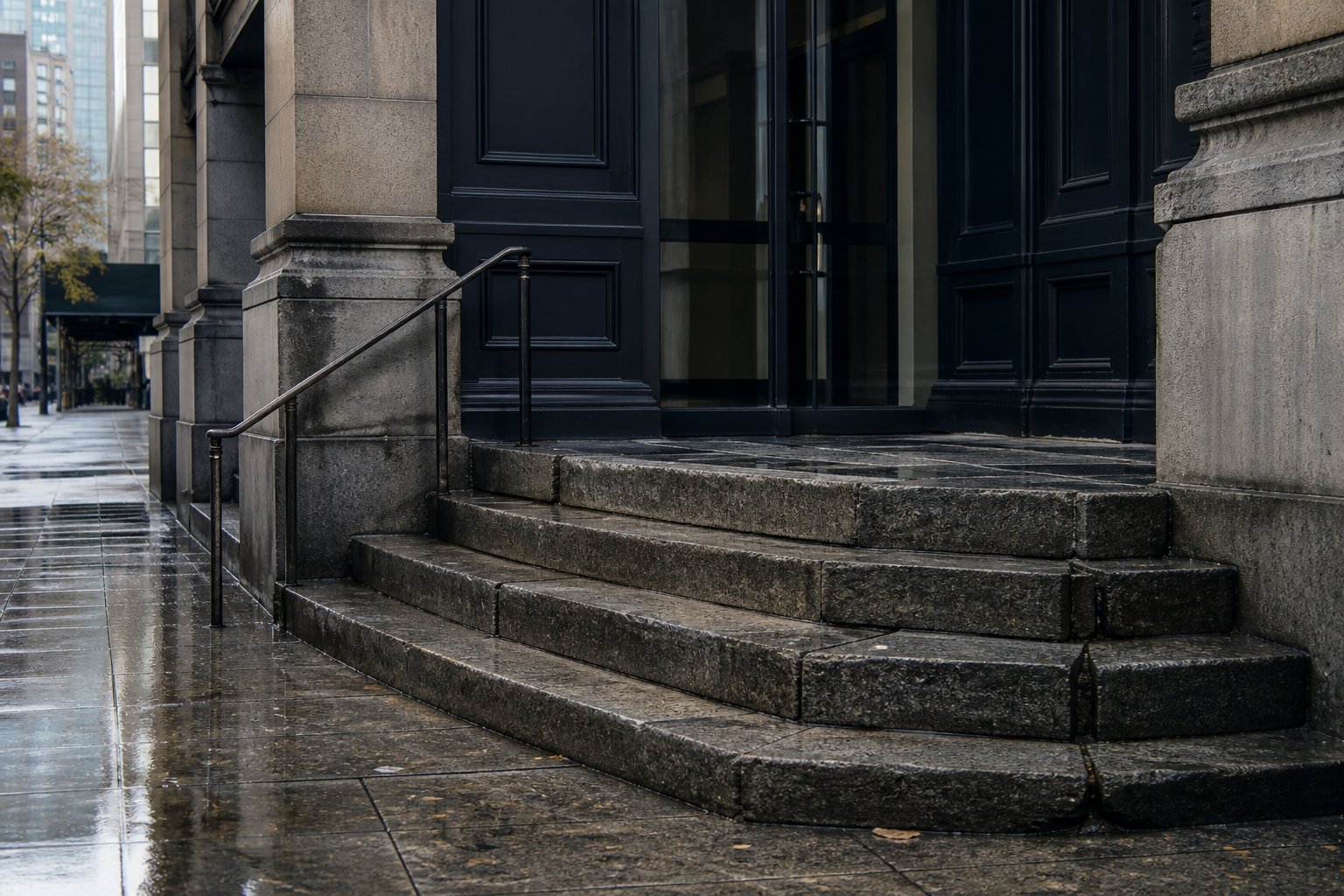
New York City Administrative Code § 7-210 generally places civil responsibility for sidewalk defects on the adjoining property owner, with a significant exception for certain one-, two-, and three-family residential properties that are owner-occupied and used exclusively for residential purposes. Whether a building qualifies for that exception is a title and use question. It is worth answering before anyone assumes the City is the only defendant, or that the City is not a defendant.
Tree wells, curb cuts, and the line between sidewalk and roadway can raise separate issues about who had the duty. City inspection records sometimes appear in sidewalk litigation. If the property is owned or operated by the City of New York, the MTA, the Port Authority, the NYC Housing Authority, or another public entity, a notice of claim is often required in a short period, commonly 90 days, with other shortening of the time to sue. A late notice is a legal problem even when the medical course is ongoing.
Comparative Fault and Defenses You May Hear
New York is a comparative-fault state. A plaintiff’s share of responsibility can reduce a recovery. It does not automatically bar the claim. Typical defense themes include looking at a phone, wearing certain shoes, taking an alternate route, or encountering a condition the defense calls open and obvious or trivial. Those arguments are fact-intensive. Lighting, crowding, the size of a sidewalk defect, and whether the person’s attention was reasonably elsewhere all come into the discussion.
Medical causation is a separate defense track. A fall can aggravate a prior back or knee condition. New York law may still allow a claim for the aggravation. Gaps in treatment and delayed first visits are often used to argue that something else caused the injury.
Building a Record After a Fall or an Assault
Seek medical care. Tell the provider where and how you fell or were attacked. If you can, report the incident in writing to the store, landlord, or manager and keep a copy. Photograph the condition, the surrounding area, lighting, weather, and your footwear. Identify cameras. Write down employee names. For an inadequate-security file, the extra documents are prior incidents, lock and camera maintenance, and how people gained access to the building. Do not give a recorded statement to an insurer until you understand who the insurer represents. Do not repair or discard physical evidence. Do not wait to calendar public-entity deadlines on the theory that you are still treating. Treatment and notice are different clocks.
Questions About a Premises Claim
If you want a New York City premises liability attorney to review an incident, Bisogno & Meyerson, LLP offers a free consultation. The meeting is a review of facts, photos, and dates. It is not a prediction of liability or of any recovery. Call (718) 745-8880 or contact Bisogno & Meyerson, LLP. The firm has concentrated in personal injury and workers’ compensation since 1994 and serves Brooklyn, Staten Island, and the five boroughs from 7018 Fort Hamilton Parkway, Brooklyn, NY 11228. Attorneys on the site are Patrick Bisogno, Esq.; Michael C. Meyerson, Esq.; and George A. Silva, Esq.
Attorney Advertising. This page is general information from Bisogno & Meyerson, LLP, not legal advice. Contacting the firm does not, by itself, create an attorney-client relationship.